

sixthgen
pastoral publishing in the 21st century
pastoral publishing in the 21st century
 You go to a mechanic to look over your car.
You go to a financial advisor to review your retirement plan. You go to a doctor to examine your health - blood work and scans. But what about your soul? Do you ever examine your spirit? For Christians, Lent is an annual soul examination. I thought about how odd this is while watching a Serta mattress commercial. They promise that their beds will improve “physical and emotional health.” We hear a lot about health in the body or mind. But what about the soul? We have millions of remedies for physical maladies - nutrition, drugs, treatments, surgeries, and mattresses for good sleep. We have ways to address mental health - counseling, therapy, rest, social connection, pills. Few address the spiritual reality of being human. The Bible has words to describe the core of who we are. Soul. Heart. Spirit. Their meaning overlaps with one another, although they all refer to an inner, hidden reality.
3 Comments
 Stop for a moment. Look at the device and the platform upon which you are reading these words. An unintended (or maybe intended) consequence of our technology is that it instigates comparative competition. We can’t help but size up our own lives in comparison to what we see of others. “How is her family so picture perfect?” “Why don’t I look like that?” “Why haven’t I gotten another degree?” “I wish I was on the beach in February.” “Why am I not married yet? Will I ever be?” Put aside the fact that you are often seeing a constructed reality. Life is generally not as good as the pictures we post. Your life is a unique creation of God, not a picture. You dare not be a parody of someone else’s curated self. You have shoes that are uniquely your own. Don’t try to fit in someone else’s. So turn off the screen, put those shoes on, and start walking the distinct life that God has willed only for you. “Criticism of others is thus an oblique form of self-commendation. We think we can make the picture hang straight on our own wall by telling our neighbor that all his pictures are crooked.” - Fulton Sheen 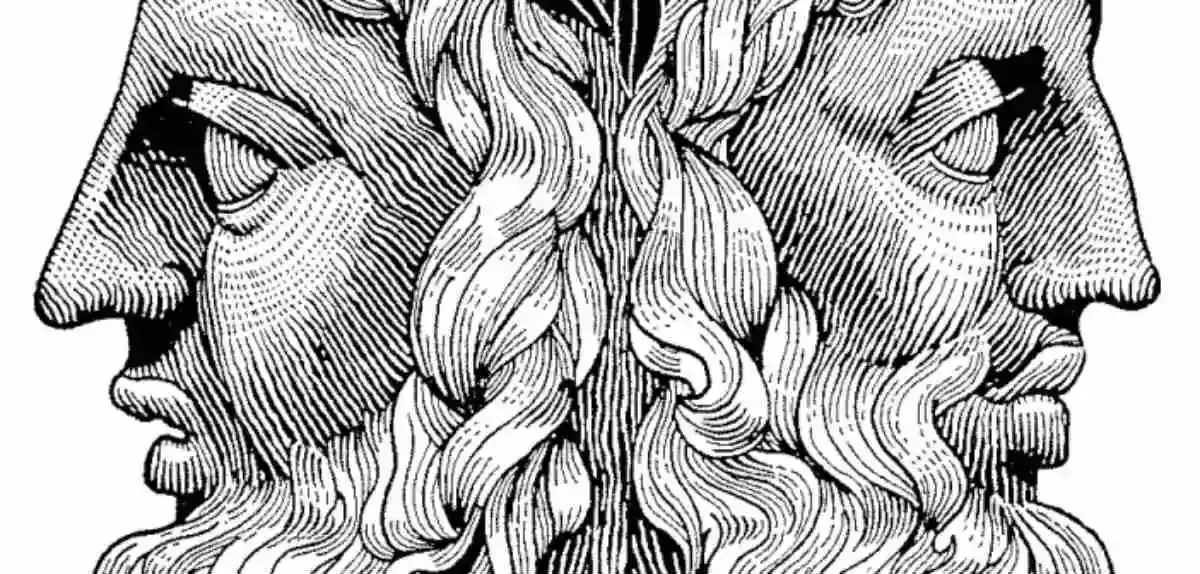 The month of January is named after the Roman god Janus. Janus has one head but two faces, each turned in opposite directions. Janus is the god of doors, gates, and transitions. So January is aptly named, a time to look back and gaze forward.
We all have Janus moments in life where we stand in a doorway between two rooms. We pause at a pivotal moment between two seasons of life. We can’t stay in the doorway. We need to set down our things and settle in a room. But there are times where we feel “in between" two places. A move. A loss. Job transition. Going off to college. A relationship change. A death. Leaving home. Retirement. Illness or injury. Marriage. Children growing up and moving on.  I’m unplugging for a while. After 17 years of ministry, my congregation has given me a three month sabbatical. I won’t respond to calls, texts, or emails. Don’t take it personally. Sabbath means “to cease/stop,” and so I’ll be doing just that. Here are a few things I’ll devote myself to.
 Not long ago, I had a week where I did four funerals. I said, “God, that’s enough. I’m done with death. I’m ready for Easter.” After a long Lent - and a long two years - we need some levity and laughter. So I have a book of Dad jokes . . .
Why can't a T Rex clap its hands? It's extinct. To whoever stole my copy of Microsoft Office, I will find you. You have my Word. Last night, my wife and I watched three movies back to back. Luckily, I was the one facing the TV. We just celebrated Easter. Why is it a big deal? Because something funny happened. Resurrection is a form of God's laughter in the face of evil.  How many predictions have you heard in the last two years? “This is what the new workspace will look like.” “This is where the economy is headed.” “This is what post-pandemic education will look like.” “Crypto will be everything!”
It happens in the church too. “Ten Ways COVID is Changing Ministry.” “Seven Keys to the Future Church.” Consultants and gurus sell books and make money from our desire to be certain about the future.  Trevor Noah, comedian and host of The Daily Show, was featured on 60 Minutes last week. I’ve been thinking about one sentence he said. “Everyone is trying to belong.”
 The Rise and Fall of Mars Hill is captivating the Christian podcast world. It chronicles the ministry of Pastor Mark Driscoll and Mars Hill Church in Seattle. Mars Hill’s explosive growth sparked one of the largest church planting movements in American history. Driscoll was a voice for a new generation of church leaders at the turn of the millennium.
The podcast uncovers all the issues under the energy of the movement. Money, celebrity, scandal, and power. Driscoll’s stated goal was a church of 50,000 people and a media platform reaching millions. He was (and is) a brash, controversial personality. In 2014 he left the church under a myriad of accusations from abusive behavior to plagiarism. Mars Hill dissolved shortly after. The church is not immunized against the lust for celebrity. We prize the platform. “Build a brand. Get noticed. Reach the masses.” We all want to be admired, to be liked, to be someone.  My counselor is “retired.” He is the former director of his counseling agency, but maintains a part time caseload of clients. Last week he told me, “I have never been busier in my whole career. And I’m retired!”
He shared how unique this present moment is. “No one alive has been through this before. In my career I witnessed Vietnam, the Civil Rights movement, 9/11, and the 2008 economic crash. But this is different. I’ve never seen as much anxiety in nearly 50 years of work.”  “How are you?” she asked. He usually says, “Good.” But today, his eyes were dark, almost bruised underneath. His hair was a mess.
“How are you?” she repeated. His only response was a five second sigh. Inexpressible exasperation. You feel like you’re carrying a backpack full of rocks and you’re not allowed to put it down. Pandemic anxiety. Masks and vaccines. Political toxicity. 9/11 remembrance. Afghan tragedy. Hurricane devastation. Future uncertainty. Families fractured . . . It is a moment in history when only a sigh will work. There are no words. At times like these, I’d like to make a case for revival. I know. You’re thinking of a big tent revival with a fired up charismatic preacher shouting and sweating behind a podium. But “revive” is a biblical word. It means to “restore to life” or “to give new strength or energy.” I want to show you this word in the Bible and how you can use it in your life. |
